
Commercial construction bidding is not simply “pricing a set of drawings.” It’s a race against time, revisions, and risk. Plans are bigger, specifications are stricter, coordination is tougher, and deadlines are shorter. One missed scope item—temporary protection, supports, access equipment, small accessories, testing requirements, or finish transitions—can quietly wipe out your margin. Meanwhile, pricing too conservatively can push your number out of contention.
That’s why professional Commercial Bid Estimating Services are a real advantage for general contractors and subcontractors who want to win more commercial work while staying profitable. When your bid is based on detailed takeoffs, clear scope documentation, and disciplined cost build-ups, you can price competitively without gambling on unknowns.
Aim Estimating provides Commercial Bid Estimating Services in the USA and UK at a very reasonable price. We deliver detailed quantity takeoffs, trade-by-trade estimate breakdowns, bid-ready summaries, and optional bid leveling—supported by modern cost estimation software, reliable cost databases, and practical quantity surveying methods. Whether you’re bidding an office renovation in New York, a retail rollout in Texas, or a hospitality project in London, we help you submit a cleaner, faster, and more defensible bid.
Aim Estimating provides Commercial Bid Estimating Services with detailed quantity takeoffs, scope notes, and bid-ready cost breakdowns for commercial projects.
We support contractors across the USA (California, Texas, Florida, New York, Illinois) and the UK (London, Manchester, Birmingham, Leeds, Bristol).
Our workflow combines expert estimators with digital takeoff tools, cost estimation software, and updated cost databases to improve accuracy and turnaround.
Deliverables include material quantities, labor cost analysis, equipment allowances, assumptions, alternates, and optional bidding support and bid leveling.
With offices in Ruislip, London and Whitefish, Montana, Aim Estimating supports both UK and US bidders with responsive communication.
Built-in QC checks and risk flags strengthen construction financial planning and improve long-term project cost control.
Commercial Bid Estimating Services

Commercial Bid Estimating Services are professional estimating solutions designed to help contractors price commercial construction projects accurately and competitively. They combine two core elements:
- Detailed quantity takeoffs (what’s required)
- Cost build-ups (what it will cost to install)
Commercial bids need a higher level of detail than most residential bids because commercial work involves:
- More trades and more handoffs
- Larger quantity volumes (small errors multiply)
- Higher compliance requirements (fire, acoustic, energy, accessibility)
- More addenda and late revisions
- More indirect costs (staging, lifts, protection, supervision, coordination)
- Complex procurement (long-lead equipment and phased buyout)
Aim Estimating’s Commercial Bid Estimating Services are built to capture full scope, reduce omissions, and provide clear documentation you can defend during tender review and after award.
Why Accurate Commercial Bid Estimates Matter for Contractors
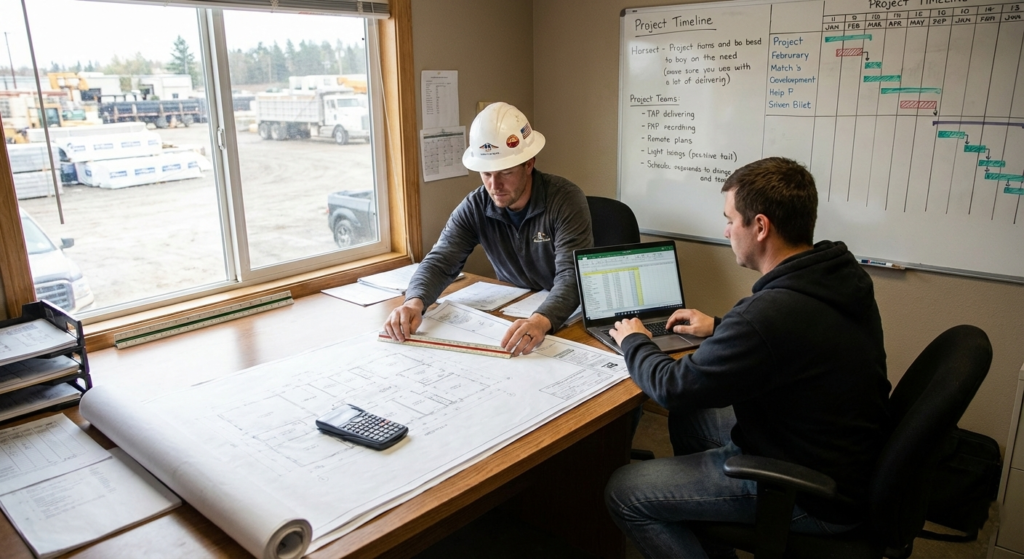
Accurate estimating affects far more than the bid total. It influences win rate, buyout performance, schedule stability, and final profit.
Competitive Pricing Powered by Cost Analysis
Accurate quantities allow real cost analysis. Instead of guessing where to cut or pad, you can see cost drivers clearly—sitework, structure, envelope, MEP, finishes—and make informed pricing decisions.
Stronger Project Budgeting for Early Decisions
Owners and GCs often request early numbers, alternates, and breakdowns. Accurate project budgeting prevents late-stage scope cuts and supports better decisions during design and procurement.
Better Construction Financial Planning

A structured estimate supports construction financial planning—cash flow, procurement timing, and staged purchasing decisions. This is essential on commercial projects where long-lead items and phased turnover are common.
Reduced Disputes Through Clear Scope of Work Estimation
Many disputes happen because scope boundaries are unclear. Documented scope of work estimation (inclusions/exclusions, assumptions) reduces conflict and protects you during change order negotiations.
Better Project Cost Control After Award
A detailed estimate becomes a baseline for project cost control—helping you track budget vs actual, forecast cost-to-complete, and manage procurement.
How Detailed Quantity Takeoffs Improve Bid Success Rates
A detailed takeoff is the foundation of a bid that wins and performs.
Takeoffs Reduce Missed Items
Many commercial bid problems come from missed accessories:
- Supports/hangers
- Fasteners, anchors, and consumables
- Firestopping coordination allowances
- Flashing/edge metal details
- Trim, transitions, and joint accessories
- Equipment pads and minor concrete
- Testing and closeout requirements (scope-based)
Detailed takeoffs reduce these gaps.
Takeoffs Improve Supplier and Sub Pricing
Suppliers and subcontractors price more accurately when they receive clean quantities. That improves quote speed and reduces the risk of “scope surprises” during buyout.
Takeoffs Enable Bid Leveling
When you have a consistent baseline, you can compare contractor quotes properly. Without a baseline, quote comparisons are often misleading.
Takeoffs Improve Labor Forecasting
Accurate quantities support more realistic labor cost analysis. You can align crew hours with actual scope volume instead of relying on generic rates.
Takeoffs Improve Change Management
When scope changes, a measured baseline helps price variations more fairly and defend your adjustments.
Common Mistakes in Commercial Bidding & Cost Estimation
Commercial bidding has predictable failure points. Most can be avoided with professional Commercial Bid Estimating Services.
Missing Scope in Details and Schedules
Many critical items appear in:
- Wall type details
- Ceiling plans and details
- Door, hardware, and finish schedules
- Specification requirements (performance and accessories)
If you measure only floor plans, you will miss scope.
Underestimating Indirects and Logistics
Commercial projects require:
- Supervision and coordination
- Protection of finished work
- Cleanup, waste handling, and disposal
- Material staging and vertical transport
- Lifts/scaffolds and safety equipment
Ignoring indirects can destroy margin.
Weak Revision/Addenda Control
Late addenda are common. If revision management is poor, your takeoff can become outdated fast.
Poor Trade Boundary Definitions
Common overlaps include:
- Sleeves, penetrations, and firestopping
- Blocking and backing for MEP
- Patching, painting, and repairs
- Equipment supports and housekeeping pads
Clear scope of work estimation prevents gaps.
Choosing the Lowest Sub Quote Without Leveling
A low subcontractor quote may exclude key items. Without bid leveling, buyout risk increases and change orders explode.
Types of Commercial Bid Estimating Services
Aim Estimating provides multiple estimating levels based on project stage and bid needs.
Conceptual & Budget Estimates
Used early for feasibility and funding decisions. These estimates support:
- Early project budgeting
- Baseline cost ranges
- Early pre-construction planning
- Preliminary risk management assumptions
Detailed Bid Estimates
The most common format for bidding. Includes:
- Detailed takeoffs
- Material, labor, equipment, and indirect cost build-ups
- Defined assumptions and scope notes
- Optional alternates and options for tender strategy
Tender / Proposal Estimates
Prepared to match tender requirements:
- Bid forms and pricing schedules
- Alternates and options
- Unit rates (when required)
- Clarifications and scope narrative
Aim Estimating can also provide bidding support to improve submission readiness.
Commercial Quantity Takeoff Services
Our Commercial Bid Estimating Services include takeoffs organized for real pricing and procurement. Depending on your needs, takeoffs can be structured by:
- CSI divisions
- Trade packages
- Floors/levels
- Zones and phases
- Alternates (base vs option)
Typical outputs include:
- Areas (SF/m²), lengths (LF/m), volumes (CY/m³), and counts (EA)
- Waste allowances (where appropriate)
- Notes explaining assumptions
- Separate categories for accessories and ancillary items
This structure helps purchasing teams, estimators, and project managers use the takeoff as a practical tool.
Commercial Project Types We Estimate
Office Buildings & Corporate Spaces
Office projects often include:
- Core and shell plus tenant fit-out scopes
- High ceiling coordination with MEP and sprinklers
- Floor-by-floor phasing and turnover requirements
Accurate takeoffs prevent missed scope in partitions, ceilings, and MEP integration.
Retail Stores, Malls & Shopping Centers
Retail work is often schedule-driven and repeatable:
- Tenant improvements and rollouts
- Standardized prototypes with local adjustments
- Finish-heavy interiors and signage coordination (scope-defined)
Accurate estimates reduce last-minute purchasing and missed opening deadlines.
Warehouses & Industrial Buildings
Warehouses are large-volume scopes where small errors multiply:
- Large slabs and concrete quantities
- Structural steel packages
- High-bay lighting and distribution
- Exterior sitework and paving (as defined)
Restaurants, Hotels & Hospitality Projects
Hospitality projects are scope-dense:
- Repetitive rooms plus complex public spaces
- Kitchens, laundry, and heavy MEP requirements
- Higher finish expectations and tighter inspection standards
These projects benefit from strict takeoff detail and risk flags.
Healthcare & Educational Facilities
These facilities often involve:
- Compliance-driven assemblies
- Higher documentation and testing requirements
- Complex MEP coordination
- Phased construction to maintain operations (when applicable)
Strong risk management and documentation are essential here.
Trade-Specific Commercial Estimating Services
Commercial projects require trade-by-trade estimating to avoid scope gaps and mispricing.
Sitework & Earthwork Takeoffs
We quantify:
- Clearing and excavation (scope-based)
- Backfill, compaction, grading
- Trenching, bedding, and restoration quantities
- Subbase, base course, paving areas
- Curbs, sidewalks, exterior concrete
Sitework often carries uncertainty, so assumptions and allowances support risk management.
Concrete & Structural Steel Estimates
We quantify:
- Footings, slabs, beams, columns, walls
- Concrete volumes and placement categories
- Reinforcement (when detailed in drawings)
- Formwork allowances (scope-based)
- Structural steel tonnage and miscellaneous metals (where shown)
Masonry, Drywall & Framing Takeoffs
We quantify:
- CMU/brick wall areas and quantities
- Stud framing (where measurable/defined)
- Drywall areas by type and rating
- Insulation and ceiling systems (per specs)
Roofing & Exterior Envelope Estimating
We quantify:
- Roofing areas by system
- Insulation thickness and coverage
- Flashings and edge details (scope-based)
- Exterior envelope scope where measurable
Envelope scope is detail-heavy; missing accessories can be expensive.
Electrical, Plumbing & HVAC Takeoffs
We support takeoffs for:
- Fixture/device counts from schedules
- Major equipment counts and distribution components
- Defined measurable conduit/pipe/duct quantities where feasible
MEP scopes require strong scope of work estimation to avoid gaps between trades.
Flooring, Painting & Interior Finishes Estimates
We quantify:
- Flooring by type with waste allowances
- Paint areas and coating systems
- Trim, transitions, and finish accessories (scope-defined)
Finish takeoffs reduce change orders and protect margin.
Detailed Cost Breakdown Reports
A commercial bid is easier to review, defend, and manage when cost reporting is structured.
Material Quantities & Pricing
We provide procurement-friendly quantities to support material cost assessment and supplier pricing:
- Line-item quantities by trade
- Accessories and small materials separated where useful
- Waste factors documented
Labour Hours & Crew Costs
We structure labor cost analysis to reflect:
- Installation complexity
- Access constraints and lift time
- Congested areas vs open areas
- Phasing and after-hours requirements (if applicable)
Equipment & Rental Costs
Commercial work often requires:
- Lifts/scaffolds
- Cranes/hoists
- Specialty access and safety equipment
Including equipment improves estimate realism and reduces cost surprises.
Subcontractor Pricing & Scope Review
Our breakdown supports:
- Sub scope review for inclusions/exclusions
- Clarification lists
- Better procurement decisions and buyout control
Bid Leveling & Subcontractor Quote Comparison
Bid leveling is essential in commercial procurement because quotes vary widely. Aim Estimating helps you:
- Compare contractor quotes against a consistent takeoff baseline
- Identify scope gaps and exclusions
- Normalize alternates and allowances
- Reduce buyout surprises and post-award change order exposure
This strengthens both bid accuracy and post-award project cost control.
Value Engineering & Cost Optimization for Commercial Projects
Commercial tenders often require options. Aim Estimating supports value engineering through:
- Quantity-backed alternates (systems, assemblies, finishes)
- Structured cost analysis showing cost drivers and savings potential
- Packaging strategies to reduce indirect costs
- Procurement timing insight for long-lead items
- Clear documentation to present options to owners/GCs
Value engineering works best when it is based on accurate quantities and realistic installation assumptions.
Estimating Software, Digital Takeoff Tools & Cost Databases
Aim Estimating uses modern systems to improve consistency and speed:
- Digital takeoff tools for accurate measurement
- Cost estimation software for structured estimating and revisions
- Updated cost databases and benchmarks
- Standard templates for repeatable reporting
Technology helps with efficiency; estimator judgment ensures completeness and constructability awareness.
Step-by-Step Commercial Bid Estimating Process
Aim Estimating follows a repeatable process to deliver consistent Commercial Bid Estimating Services:
- Plans & specs intake and review
Identify scope boundaries, alternates, and key specification requirements. - Pre-construction planning inputs
Document assumptions, constraints, and procurement considerations to support pre-construction planning. - Trade-by-trade takeoff
Measure quantities by trade, floor, zone, or phase as needed. - Cost build-up and cost analysis
Build costs for material, labor, equipment, and indirects, supported by structured cost analysis. - Quote review and optional bidding support
Review contractor quotes, level bids, and prepare clarifications and alternates. - Quality control and final delivery
Cross-check schedules, validate units, review details, and finalize bid-ready reports.
This workflow is designed to balance speed with accuracy—critical in commercial bidding.
Quality Control & Accuracy Verification
Quality control protects profit. Aim Estimating uses:
- Cross-checking counts against schedules (doors, fixtures, equipment)
- Sanity checks for areas/volumes vs building footprint
- Detail sheet review for accessories and hidden scope
- Unit consistency and conversion verification
- Documented assumptions for clear risk management and scope of work estimation
QC reduces missed scope and strengthens bid defensibility.
Risk Assessment & Contingency Planning in Commercial Bids
Commercial bids require disciplined contingency, not blanket padding. Our estimating approach supports risk management by:
- Identifying unclear scope and incomplete information
- Highlighting coordination-sensitive areas
- Flagging long-lead procurement risks
- Documenting allowances where appropriate
- Supporting cost forecasting for construction financial planning
This helps avoid the common scenario of “winning the bid and losing the job.”
Benefits of Outsourcing Commercial Bid Estimating Services
Outsourcing Commercial Bid Estimating Services with Aim Estimating helps contractors:
- Bid more projects without overloading internal teams
- Improve accuracy and reduce missed items
- Respond faster to addenda and revisions
- Improve tender submissions with clearer documentation
- Strengthen buyout decisions through bid leveling
- Build a stronger baseline for project cost control after award
- Maintain competitive pricing with better material cost assessment and labor structure
For many contractors, outsourcing is a growth strategy that stabilizes estimating output.
Service Coverage Areas
USA
We support Commercial Bid Estimating Services in:
- California
- Texas
- Florida
- New York
- Illinois
UK
We support Commercial Bid Estimating Services in:
- London
- Manchester
- Birmingham
- Leeds
- Bristol
Why Choose Our Commercial Bid Estimating Services (USA & UK)
Contractors choose Aim Estimating because we focus on what wins bids and protects margins:
- Detailed takeoffs built for real installation scope
- Strong quantity surveying discipline and traceable reporting
- Modern workflow using cost estimation software
- Transparent assumptions and scope notes
- Optional bidding support, bid leveling, and alternates
- Data-driven value engineering supported by accurate quantities
- Very reasonable pricing in both the USA and UK
We deliver Commercial Bid Estimating Services that help contractors submit competitive bids—then execute with clarity and control.
Turnaround Time, Deliverables & Pricing Packages
Turnaround time depends on:
- Project size and complexity
- Trades included
- Bid deadline and addenda volume
- Deliverable type (takeoff-only, full estimate, tender format)
Typical deliverables include:
- Detailed trade-wise takeoffs (SF/LF/CY/EA)
- Bid-level cost breakdowns (material, labor, equipment, indirects)
- Scope notes, assumptions, inclusions/exclusions
- Alternates and options (as requested)
- Bid leveling and quote comparisons (optional)
Pricing packages are designed to remain very reasonable while maintaining detail and quality control.
FAQs – Commercial Bid Estimating & Takeoff Services (Trending)
What’s included in Commercial Bid Estimating Services?
Trade-by-trade quantity takeoffs, structured cost breakdowns, scope notes, assumptions, and bid-ready summaries—with optional bid leveling and bidding support.
Which items are most commonly missed in commercial bids?
Indirects, accessories, supports, temporary works, protection, testing/commissioning, and trade boundary items (firestopping, patching) are common misses. Detailed takeoffs reduce these gaps.
Can bid estimates help after award?
Yes. They provide a baseline for procurement and project cost control, supporting buyout, budget tracking, and change management.
Can you help compare subcontractor quotes?
Yes. We level contractor quotes against a consistent baseline and highlight exclusions to reduce buyout surprises.
Do you provide value engineering options?
Yes. We support value engineering using accurate quantities and structured cost analysis to compare alternates and options.
Do you support both USA and UK commercial bids?
Yes. Aim Estimating provides Commercial Bid Estimating Services for both the USA and UK, aligned to tender requirements and reporting expectations.
Call to Action
If you need accurate quantities, structured bid pricing, and fast turnaround, contact Aim Estimating today. We provide professional Commercial Bid Estimating Services in the USA and UK at a very reasonable price.
UK Office: 2nd Floor College House, 17 King Edwards Road, RUISLIP, London HA4 7AE
Phone: 07403 804117
USA Office: 6479 US HWY 93 S unit 445, WhiteFish, Montana 59937
Phone: +14063160085
Send your drawings and bid deadline now and receive Commercial Bid Estimating Services from Aim Estimating—detailed takeoffs, clear documentation, and bid-ready breakdowns built to help you win more commercial projects.